Project Overview
This project focused on analyzing Amazon Prime subscriber data to build predictive models that identify factors influencing users' subscription plan choices between Annual and Monthly plans. The insights aim to help optimize subscription offerings, improve customer retention, and enhance overall user satisfaction.
Key Achievement
Developed a Decision Tree model that achieved an F1-score of 58.3%, recall of 60.6%, and accuracy of 54.7% in predicting subscription plan preferences, providing actionable insights for targeted marketing and retention strategies.
Data & Methodology
The analysis utilized Amazon Prime subscriber data containing demographic information, engagement metrics (such as usage frequency and favorite genres), and behavioral patterns (including renewal status and payment methods).
Project Workflow
- Data Preprocessing: Cleaned the dataset, handled missing values, and encoded categorical variables
- Exploratory Data Analysis: Identified patterns and correlations between features and subscription plan choices
- Feature Selection: Determined the most influential variables for predicting plan preferences
- Model Development: Trained and evaluated multiple machine learning models
- Model Evaluation: Compared performance metrics to select the best model
- Insights & Recommendations: Derived actionable strategies based on model findings

Workflow diagram showing the end-to-end process from data preprocessing to recommendations
Modeling Approach
I implemented and compared multiple machine learning algorithms to find the most effective approach for predicting subscription plan preferences:
- Decision Tree
- Random Forest
- XGBoost
# Model training and evaluation code snippet
from sklearn.model_selection import train_test_split
from sklearn.tree import DecisionTreeClassifier
from sklearn.metrics import classification_report, accuracy_score, f1_score, recall_score

# Split data
X_train, X_test, y_train, y_test = train_test_split(X, y, test_size=0.3, random_state=42)

# Train Decision Tree model
dt_model = DecisionTreeClassifier(random_state=42)
dt_model.fit(X_train, y_train)

# Make predictions
y_pred = dt_model.predict(X_test)

# Evaluate model
accuracy = accuracy_score(y_test, y_pred)
f1 = f1_score(y_test, y_pred)
recall = recall_score(y_test, y_pred)

print(f"Accuracy: {accuracy:.3f}")
print(f"F1-Score: {f1:.3f}")
print(f"Recall: {recall:.3f}")
print("\nClassification Report:\n", classification_report(y_test, y_pred))
Model Performance
After evaluating multiple models, the Decision Tree algorithm emerged as the best performer for this specific prediction task.
Accuracy
Overall prediction correctness
F1-Score
Balance of precision and recall
Recall
True positive rate

Performance comparison of different modeling approaches
While the accuracy metrics might appear moderate, they represent a significant improvement over baseline predictions in this complex domain where subscription choices are influenced by numerous subtle factors.
Key Findings
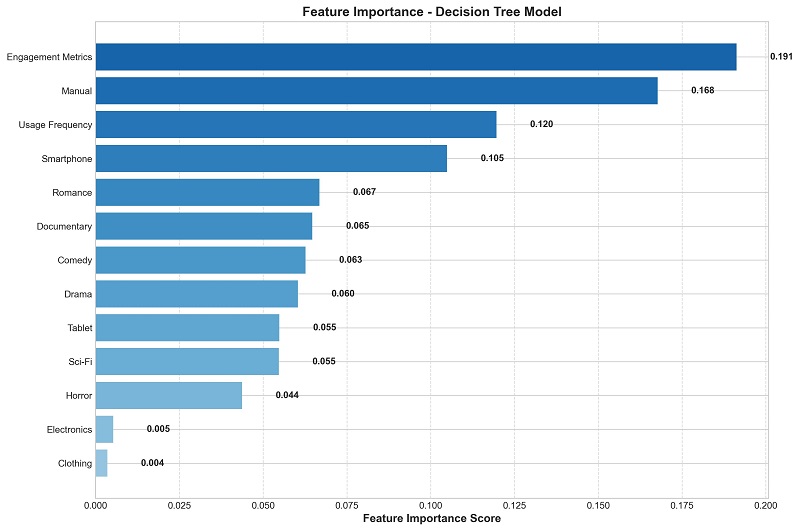
Feature importance chart showing the top factors influencing subscription plan choice
Critical Factors Influencing Plan Choice
The analysis revealed several key factors that significantly impact users' subscription plan preferences:
- Engagement Metrics: Higher engagement levels correlated with preference for Annual plans
- Renewal Status: Users with automatic renewals were more likely to choose Annual plans
- Usage Frequency: Regular, consistent usage patterns influenced plan selection
- Customer Support Interactions: More frequent support interactions were associated with Monthly plan preferences
Subscriber Behavior Patterns
Annual plan subscribers typically showed higher engagement and loyalty, while Monthly plan subscribers exhibited more variable usage patterns and required more customer support assistance.
Recommendations
Based on the model insights, I developed the following actionable recommendations:
- Personalized Subscription Plans: Offer customized plans based on users' usage patterns and favorite content genres
- Targeted Retention Campaigns: Identify users at risk of churning and target them with specific promotional offers
- Optimized Renewal Strategies: Implement timely renewal reminders and incentives for auto-renewal enrollment
- Enhanced Customer Support: Improve support services for users showing patterns associated with churn risk
Business Impact
Implementation of these data-driven strategies could significantly improve customer retention rates and optimize the distribution of subscription plans, ultimately enhancing revenue and customer satisfaction.
Conclusion & Future Work
This project successfully identified key factors influencing Amazon Prime users' subscription plan preferences and developed a predictive model to guide business strategies. The insights provide a foundation for more personalized marketing approaches and improved customer retention efforts.
Future work could expand on these findings by:
- Incorporating additional data sources such as content viewing history and browsing patterns
- Implementing more advanced ensemble methods to improve prediction accuracy
- Developing time-series models to capture seasonal variations in subscription preferences
- Creating a real-time recommendation system for personalized subscription offers