Executive Summary
This research examines global suicide trends from 1985 to 2016, analyzing patterns across time, gender, geography, and economic factors. The study specifically investigates whether a country's GDP affects its suicide rates, challenging common assumptions about economic prosperity and mental health outcomes.
Key Finding
Statistical analysis found no significant correlation between a country's GDP (both annual and per capita) and its suicide rates, with p-values of 0.846 and 0.460 respectively. This challenges the assumption that economic factors are primary drivers of suicide rates across countries.
Study Period
1985–2016
Countries Analyzed
Across multiple continents
Gender Disparity
Male to female suicide ratio
Global Trends & Patterns
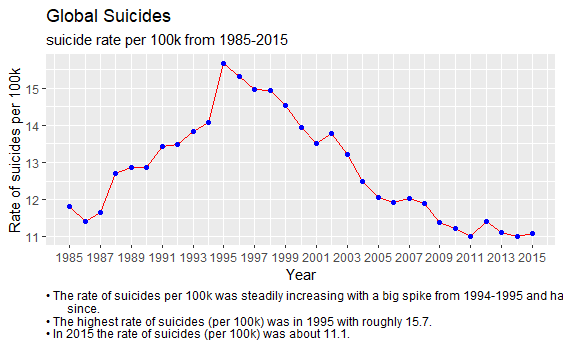
Global suicide rates over time, showing peak in 1995 and subsequent decline
Temporal Trends
The analysis revealed distinct patterns in global suicide rates over the 31-year study period:
- Global suicide rates increased until 2002 and have since decreased
- The highest rate occurred in 1995 (15.7 per 100,000 population)
- By 2015, rates had fallen to 11.1 per 100,000 population
- The trend shows a clear inverted U-shape pattern over the study period
Gender Disparities
The study found significant differences in suicide rates between males and females:
- Males have approximately four times higher suicide rates than females (20 vs. 5.4 per 100,000)
- Male suicide rates fluctuated significantly, peaking in 1995
- Female rates have steadily decreased since 1985 without major spikes
- The gender disparity persisted across all regions and time periods
Regional Variations
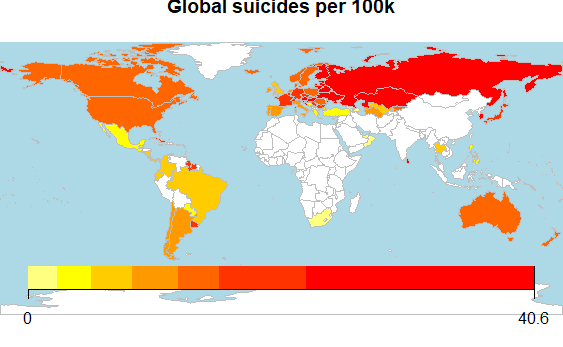
European and Asian regions show approximately double the suicide rates of North America and Australia, with Lithuania having the highest rate (68.14 per 100,000 for males). This suggests that cultural, social, and healthcare factors may play more significant roles than economic development.
Economic Analysis
A central question of this research was whether economic factors, particularly GDP, correlate with suicide rates across countries. The analysis tested both annual GDP and GDP per capita as potential predictors.
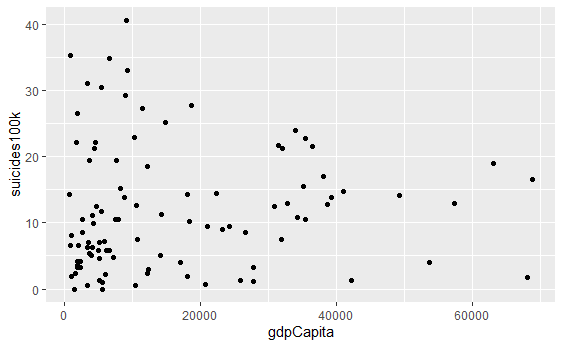
Scatter plot showing lack of correlation between GDP per capita and suicide rates
Statistical Findings
The regression analysis found no statistically significant relationship between GDP metrics and suicide rates:
- Annual GDP correlation: p-value = 0.846 (not significant)
- GDP per capita correlation: p-value = 0.460 (not significant)
- R-squared values were extremely low, indicating GDP explains very little variance in suicide rates
Regression Model Specifications
The analysis employed multiple regression models to test the relationship between economic factors and suicide rates:
Model 1: Annual GDP
lm(formula = suicide_rate ~ annual_gdp, data = country_data)

Coefficients:
              Estimate   Std. Error   t value   Pr(>|t|)
(Intercept)  1.324e+01   5.629e-01    23.52    <2e-16 ***
annual_gdp   3.139e-14   1.607e-13     0.20     0.846

Residual standard error: 5.63 on 99 degrees of freedom
Multiple R-squared:  0.0003865, Adjusted R-squared:  -0.009707
F-statistic: 0.03825 on 1 and 99 DF,  p-value: 0.8454
Model 2: GDP Per Capita
lm(formula = suicide_rate ~ gdp_per_capita, data = country_data)

Coefficients:
                 Estimate   Std. Error   t value   Pr(>|t|)
(Intercept)     1.287e+01   6.515e-01    19.76    <2e-16 ***
gdp_per_capita  4.836e-05   6.515e-05     0.74     0.460

Residual standard error: 5.619 on 99 degrees of freedom
Multiple R-squared:  0.005531, Adjusted R-squared:  -0.004517
F-statistic: 0.5501 on 1 and 99 DF,  p-value: 0.4599
Data Limitations
- Missing data from many African countries and parts of South America and Southern Asia
- Potential underreporting in countries with strong religious or cultural taboos around suicide
- Variations in reporting methods and definitions across countries
- Limited socioeconomic variables beyond GDP metrics
Research Implications
Mental Health Policy
The findings suggest that mental health interventions should not be based solely on economic development indicators, as GDP appears unrelated to suicide rates.
Regional Approaches
The significant regional variations indicate that culturally specific approaches to suicide prevention may be more effective than universal strategies.
Gender-Specific Programs
The consistent 4:1 male-to-female suicide ratio suggests the need for gender-specific mental health interventions, particularly targeting men.
COVID-19 Context
This research established a baseline understanding for comparison with future data, particularly from the COVID-19 pandemic period. The findings suggest that economic downturns alone may not necessarily lead to increased suicide rates, though more research is needed on this specific relationship.
Conclusion & Future Directions
This analysis challenges common assumptions about the relationship between economic prosperity and suicide rates. The lack of correlation between GDP indicators and suicide rates suggests that mental health outcomes are influenced by a complex interplay of factors beyond economic development.
Key Takeaways
- Global suicide rates peaked in 1995 and have since declined
- Males have consistently higher suicide rates than females across all regions
- European and Asian regions show approximately double the suicide rates of North America and Australia
- No significant correlation exists between GDP metrics and suicide rates
- The data has limitations, particularly the lack of information from African countries
Future Research Directions
- Investigating cultural, social, and healthcare factors that may better explain regional variations
- Examining the impact of specific mental health policies and interventions on suicide rates
- Analyzing the effects of the COVID-19 pandemic on global mental health patterns
- Exploring gender-specific risk factors and protective factors for suicide
- Developing more comprehensive data collection methods to include underrepresented regions